Quick start

Goo
A local-first, open-source AI coding assistant for your terminal — powered by Ollama, with file-aware conversations, code editing, and persistent memory you actually own.
GooGo is an experimental AI coding assistant that runs directly in your terminal and works with local language models through Ollama.
The goal is simple: build a coding assistant that can understand your project, read and modify code, remember useful context across conversations, and keep that memory transparent and accessible to you.
Unlike memory systems hidden inside a database, GooGo uses a local Markdown vault as its source of truth. Your memories remain readable, editable, and portable — and can be explored visually using Obsidian.
Note: GooGo is currently under active development. APIs, commands, and features may change.
Features
- Chat with local Ollama models directly from your terminal
- Built with Bun and TypeScript
- Streaming AI responses
- Reference project files using
@filename - File search and autocomplete
- AI-powered function editing
- Function creation and modification
- Function renaming
- Function deletion
- Code diff previews
- Persistent long-term memory
- SQLite-powered vector index
- Markdown-based memory vault
- Obsidian-compatible memory storage
- Explore memories using Obsidian Graph View
- Syntax-highlighted code output
- Local conversation history
How GooGo Works
At a high level:
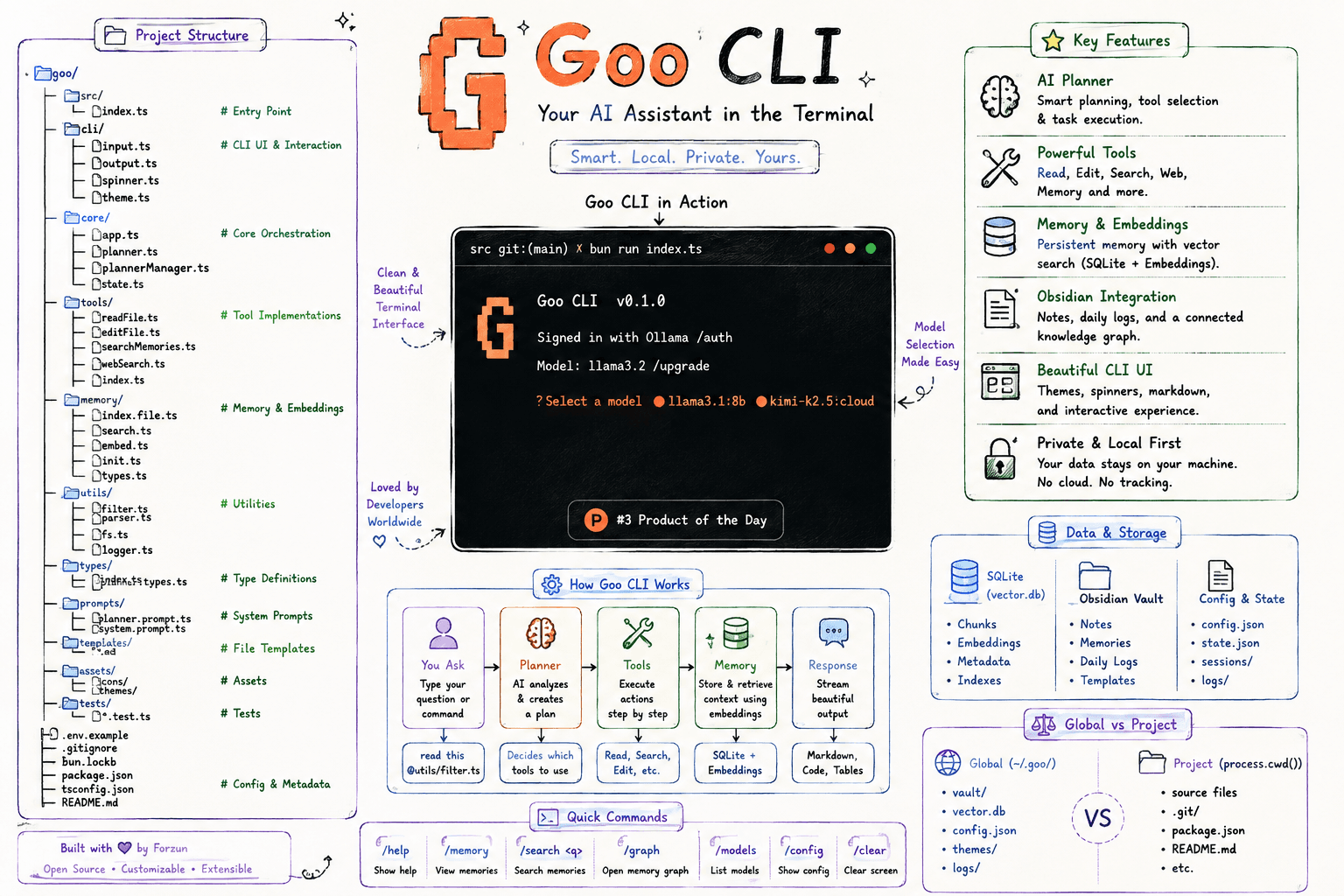
GooGo uses the Ollama API to communicate with models running locally on your machine.
Your code stays on your machine unless you explicitly configure GooGo to use an external service in the future.
Requirements
Before installing GooGo, make sure you have:
- Git
- Bun
- Ollama
- At least one Ollama chat/coding model
- An embedding model for memory
Obsidian is optional, but recommended if you want to browse and visualize GooGo's memory vault.